


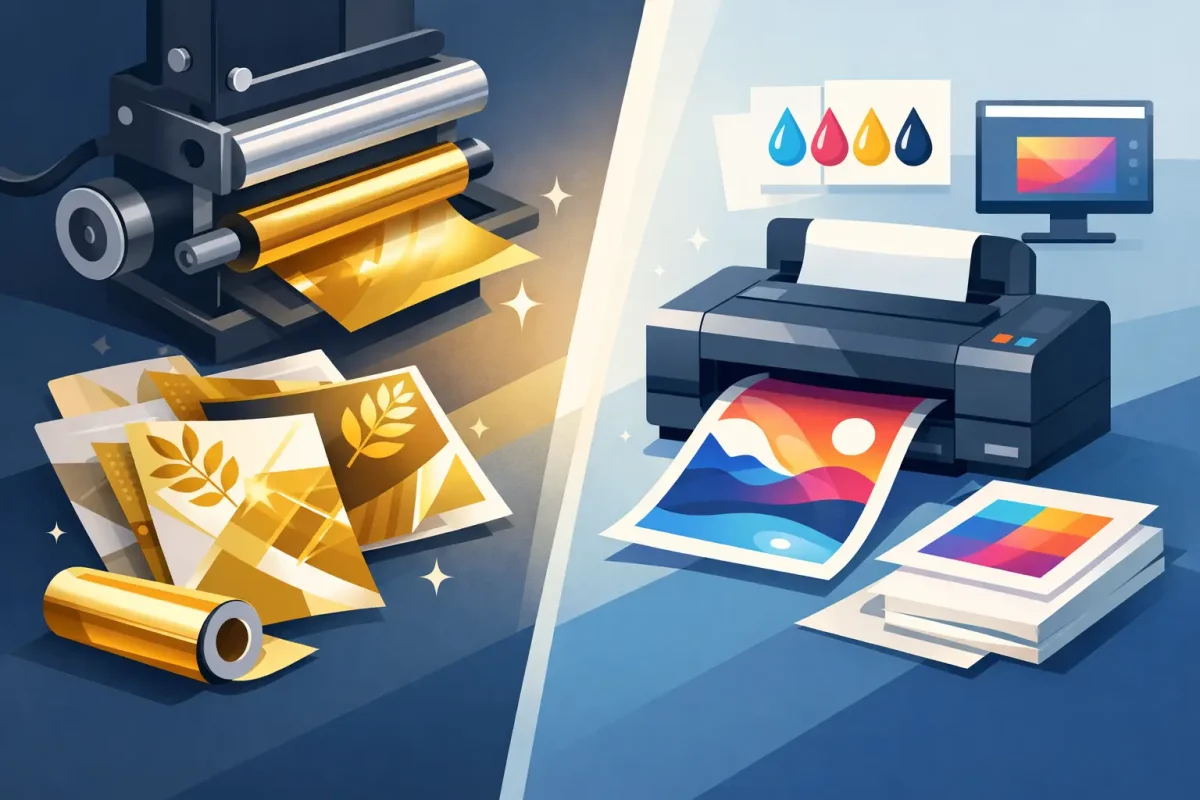
A menu with metallic gold detail says something very different from the same menu printed in flat ink. So does a loyalty card with a crisp foil logo, or a business card with a clean digital finish delivered quickly for a new launch. When weighing up foil printing vs digital printing, the real question is not which method is better in general. It is which one suits the job, the budget and the impression you need to make.
For many businesses, both processes have a place. One is built for speed, flexibility and everyday practicality. The other is chosen for impact, texture and a more premium result. If you are ordering print for hospitality, retail, salons, events or branded business materials, understanding where each method works best helps you avoid over-ordering, under-specifying or paying for a finish you do not need.
Foil printing vs digital printing: the core difference
Digital printing applies printed artwork directly to the stock using toner or ink-based technology, depending on the press. It is efficient, accurate and well suited to short runs, variable artwork and standard brand materials. If you need flyers, menus, invitations, folders or cards produced quickly without making plates, digital is often the practical choice.
Foil printing is different. Rather than printing colour in the usual sense, it uses heat and pressure to transfer a metallic or pigmented foil onto the surface. In commercial applications, this is often hot foil printing. The result is a reflective finish that catches light and gives the design a sharper decorative contrast than standard ink alone. It is often used for logos, names, borders, patterns and highlighted elements where presentation matters.
That difference matters because the two methods solve different business problems. Digital printing is usually about efficient production. Foil printing is about visual value.
When digital printing is the better fit
If your priority is speed, flexibility or cost control on shorter runs, digital printing usually makes more sense. There is less setup involved, which keeps lead times and initial costs lower. That makes it useful for day-to-day printed products where information changes often or where you need to test a design before committing to larger volumes.
Restaurants and hotels often benefit from digital print for seasonal menus, event inserts and promotional leaflets because artwork can be updated without the extra preparation involved in specialist finishing. Salons may choose digital for appointment cards, price lists or flyers that need regular revisions. Retailers often use it for signage, handouts, labels and inserts where turnaround is more important than decorative finish.
Digital is also the easier route when a design contains gradients, full-colour photography or multiple visual elements. It handles complex artwork well and keeps the process straightforward. If you need versioned print, such as personalised invitations, numbered vouchers or region-specific collateral, digital production is typically more efficient.
That does not mean digital looks cheap. On the right stock, with well-prepared artwork, it can look clean, professional and completely appropriate for customer-facing use. For many businesses, that is exactly what is needed.
Practical strengths of digital printing
Digital printing works well when timelines are tight and quantities are modest. It is often the most sensible option for standard business cards, leaflets, posters, folders and paper-based promotional print.
It also gives buyers more freedom to reorder in smaller batches. That helps if you are managing stock carefully, updating staff details, changing offers or testing new branding. You are not locked into a large run just to make the setup worthwhile.
Where foil printing earns its place
Foil printing comes into its own when the printed item needs to feel more valuable, more deliberate or more brand-led. A foil logo on a loyalty card, gift card, certificate or invitation creates a finish that customers notice in the hand as well as at first glance.
This is especially useful in sectors where presentation affects perceived quality. Hotels use foil on menus, room collateral and branded stationery because it adds polish without needing an overly busy design. Salons and beauty brands often choose foil for appointment cards, gift vouchers and packaging inserts because metallic detail supports a more premium brand position. Retailers can use foil on swing tags, printed bags and promotional cards where shelf appeal matters.
Foil is also strong for trust-led applications. Certificates of authenticity, membership cards, scratch cards and premium plastic cards often benefit from foil because it adds distinction and can make the item harder to dismiss as routine print. In some cases, it supports both branding and credibility.
The trade-off is that foil printing is usually less flexible than digital for constant design changes. It tends to involve more setup and is more suited to stable artwork where the added finish is intentional, not incidental.
What foil printing changes visually
Foil reflects light in a way standard ink cannot. Gold, silver and other metallic shades can produce a polished, high-contrast effect even with very simple artwork. That means you do not need an elaborate design to make use of it. In fact, foil often works best when applied with restraint.
A business card with a foil logo and minimal text can look more considered than a fully loaded design printed in several colours. The same applies to menus, invitations and branded cards. Foil is rarely about adding more. It is about choosing one or two details worth highlighting.
Cost, quantity and turnaround
This is often where the decision becomes clearer.
Digital printing is generally the more cost-effective option for short runs and fast-moving projects. Because setup is simpler, it is easier to produce smaller quantities without the unit cost becoming disproportionate. If you need 100 flyers, 50 invitations or a quick batch of updated cards, digital usually offers better commercial sense.
Foil printing carries more production value, but that comes with extra process. Dies, setup, positioning and finishing can all affect pricing and lead time depending on the product. If the foil is central to the design and the item itself has a higher perceived value, that additional cost may be justified. If the print is temporary, informational or likely to change next month, it may not be.
There is also the issue of wastage and planning. With foil, artwork needs to be prepared more carefully. Fine details, registration and stock choice all matter. That is not a disadvantage if the project deserves the attention, but it does mean foil is less suited to rushed, last-minute decision-making.
Stock, durability and product type
The substrate matters as much as the print method.
Digital printing is versatile across a wide range of paper and card stocks, and works well for many standard commercial products. Foil printing also depends heavily on stock compatibility, but when matched properly it can produce a much more tactile result. Uncoated, coated and laminated materials can all behave differently under foil, so the product specification needs to be considered early.
For plastic cards, foil can be particularly effective because the reflective finish complements the durability of the card itself. That combination suits loyalty cards, membership cards, gift cards and VIP passes where the item stays in circulation and represents the brand repeatedly. On paper products such as invitations, folders or certificates, foil adds formality and visual weight.
If a product is going to be handled frequently, displayed under lighting or used as part of a premium customer journey, foil often gives a better return on the visual investment. If it is disposable, temporary or mostly functional, digital may be the smarter route.
Foil printing vs digital printing for common business uses
For everyday marketing collateral, digital printing usually wins on practicality. Flyers, posters, inserts, forms and short-run menus are often better produced digitally because they need speed and easy revision.
For presentation-led items, foil has the edge. Business cards for senior staff, gift vouchers, branded folders, certificates, high-end invitations and premium menus all benefit from the added finish when the design is appropriate.
Some projects benefit from using both. A digitally printed item can include foil as a finishing element, depending on the specification and product. That can be a sensible middle ground for brands that want efficient production with one premium detail. It is not always necessary, but for some customer-facing print it gives the best balance of practicality and impact.
How to choose without overcomplicating it
Start with the purpose of the printed item. Ask whether it is mainly there to inform, to promote, or to represent the brand at a higher level. If the answer is speed and function, digital is probably right. If the answer is presentation and perceived value, foil is worth serious consideration.
Next, consider how often the artwork will change. Frequent updates favour digital. Stable branding and repeat designs are more compatible with foil.
Then look at the setting in which the item will be used. A takeaway menu insert has very different demands from a hotel drinks menu. A promotional postcard has different expectations from a gift card handed over at the till. Context should guide the finish.
At Pressola, this is often where customers benefit from discussing the product rather than thinking only about the artwork. The same logo can behave very differently on a flyer, a plastic card or a certificate, and the right print method depends on the role that item plays in the business.
The best choice is usually the one that fits the job without forcing the budget or diluting the brand. If you want print that works hard, let the purpose lead the specification and the finish will follow.