


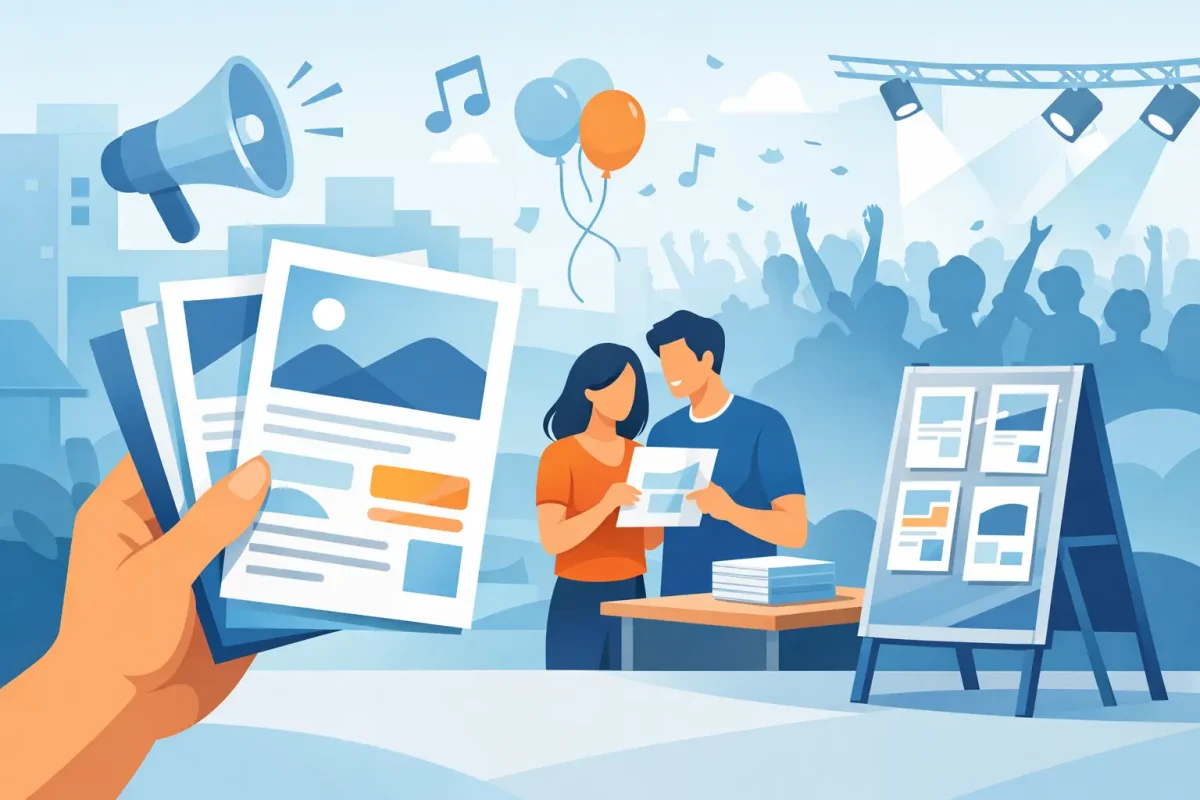
A stack of event flyers on a counter tells you very quickly whether a promotion has been planned properly. If the paper feels flimsy, the message is vague, or the design tries to say everything at once, most of them will be ignored. Flyer printing for events still works, but only when the print choices support the event itself and the audience you need to reach.
For local businesses, venues, organisers and brands, flyers remain one of the most practical ways to promote a date, launch, opening night, seasonal campaign or ticketed event. They are affordable at volume, easy to distribute, and useful in places where digital ads are either too broad or too easy to scroll past. The key is treating flyers as a working sales tool rather than a box-ticking exercise.
Why flyer printing for events still earns its place
Event promotion often needs speed, reach and local visibility. Flyers do all three well. They can be handed out in person, placed at tills, packed into orders, displayed at reception desks, or left in partner venues where your audience already spends time.
That matters for hospitality businesses, salons, retailers, community groups and regional organisers. If you are promoting a bottomless brunch, a charity night, a wedding fair, a product launch or an in-store event, a flyer puts the message directly into someone’s hand. It does not rely on algorithms or ad budgets continuing to perform.
Print also gives your campaign a physical presence. A good flyer can sit on a desk, a kitchen counter or a reception area for days. That extra visibility is useful when people are deciding whether to book, attend or pass the message on.
There is a trade-off, of course. Print needs planning. If your event details are likely to change at short notice, digital channels are more flexible. But where the date, venue and offer are confirmed, flyers often provide better local recall than a hurried social post.
Choosing the right flyer format for events
The best format depends on how the flyer will be used, not just how much information you want to fit on it. A6 works well for handouts, bag drops and quick promotional pieces. It is compact, cost-effective and easy for people to keep. A5 is often the safer choice for event marketing because it gives you more room for a strong headline, core details and brand visuals without feeling crowded.
DL flyers are useful when you want a more refined, narrow format, particularly for hospitality offers, invitations or venue-led promotions. A4 can work for noticeboards, reception displays or information-heavy event pieces, but it is usually less practical for street distribution.
This is where many businesses overcomplicate things. Bigger is not always better. If the flyer needs to be carried in a pocket or handbag, a smaller format may perform better than a large one with more copy. If the event is premium, a standard size with better stock and sharper finishing often creates a stronger impression than simply increasing dimensions.
Paper stock and finish matter more than most people think
People notice paper quality immediately, even if they do not say so. Stock affects how professional the event looks before anyone reads a word. For a nightclub promotion or a one-day retail event, a lighter-weight flyer may be perfectly practical. For a hotel event, corporate function, salon launch or premium brand activation, heavier stock usually earns its keep.
Silk and gloss finishes tend to suit image-led designs and bold colour work. Matt can feel more understated and is often easier to read under strong lighting. Uncoated stock can work well when you want a more tactile, natural or artisanal look, but it will not suit every brand.
The point is not to choose the most expensive option by default. It is to match the print specification to the commercial value of the event. If you are selling high-ticket places, promoting a polished venue experience or trying to reinforce brand quality, flimsy stock can undermine the message. If you need mass reach for a short-term campaign, keeping the unit cost lower may be the smarter decision.
What to include on an event flyer
The strongest event flyers do not try to explain everything. They prioritise the details that help someone decide quickly. In most cases, that means the event name, date, time, location, a clear reason to attend, and a simple next step.
That next step might be booking, calling, scanning a code at point of contact, or visiting a ticket page later through a memorable prompt. The wording should be direct. If there is an offer, make it visible. If places are limited, say so plainly. If entry is free, do not bury that detail halfway down the page.
Too much copy is one of the most common problems in flyer printing for events. A flyer is not a brochure. It should create enough interest to drive action, not answer every possible question. Where extra information is essential, layout matters. Break text cleanly, keep headings obvious, and give the page room to breathe.
Design choices that help flyers perform
A flyer needs to be readable in seconds. That usually means one clear headline, one visual direction and one main message. When a design tries to promote the DJ line-up, the food offer, the venue story, the sponsor logos and the booking terms all at once, the result is often weak.
Brand consistency matters here. Your flyer should look like it belongs with your menus, posters, invitations, signage or wider event materials. For businesses ordering across multiple categories, this is one of the practical advantages of using a single print supplier. It is easier to keep colours, typography and overall presentation aligned.
Images need to be high enough quality for print, and artwork should be built to the correct size with bleed and safe areas accounted for. If text sits too close to the edge, or low-resolution images are stretched to fill the page, the final result will look cheaper than intended.
There is also a straightforward commercial point to remember. Clever design is not useful if the event details are hard to find. Decorative choices should support clarity, not compete with it.
Timing your flyer print run properly
One reason event flyers fail is not the design or the stock. It is timing. Print too early and details may change. Print too late and distribution becomes rushed, reducing the value of the run.
For most local and regional events, you need enough lead time to receive the flyers, check them, and distribute them properly before the date. That may mean staggered activity across a few weeks rather than a single drop. A restaurant might place flyers in takeaway bags for two weekends before a themed night. A salon might hand them out at the desk during every appointment in the month before a launch event. A retailer may combine in-store handouts with till-point displays and window posters.
The right quantity depends on that plan. Ordering too few limits reach. Ordering too many can leave you with waste if the event has a short shelf life. If the event is recurring, a more flexible print approach with reusable design elements may make better sense than one oversized run.
Where printed event flyers work best
Flyers are most effective when distribution is targeted. Handing out thousands of copies in places with little audience relevance can be expensive and disappointing. Smaller, better-placed runs often do more.
Hospitality venues can place flyers at tables, bars, reception desks and partner businesses. Salons can include them in retail bags or display them at the counter. Hotels can use them to promote functions, dining offers or seasonal events to current guests. Community organisers can place them in cafés, independent shops, leisure facilities and local business hubs.
Think about context. A flyer for a wedding showcase belongs in bridal retail spaces, hotels and beauty businesses. A flyer for a student event belongs near the audience’s daily routes. Distribution works best when the event offer fits the location naturally.
Getting better value from your event print
A flyer rarely works alone. It tends to perform better as part of a set of matching printed materials. Posters extend visibility. Invitations add a more direct route for selected guests. Vinyl banners help on-site promotion. Printed folders or inserts can support sponsor packs, event information or corporate presentations.
This joined-up approach is often more efficient than treating each item as a separate purchase. It also strengthens consistency, which matters when the event is part of a broader brand campaign.
For businesses that run regular promotions, reviewing results matters too. Ask where attendees heard about the event. Track whether certain locations or handout points produce stronger response. Over time, that helps you print smarter, not just more.
A well-produced flyer does a simple job well. It gets noticed, gives people a reason to act, and reflects the quality of the event behind it. If the format, stock, artwork and timing are right, flyer printing becomes less about filling space and more about filling the room.